Skip to documentation
PAUTINKAAudio Motion System 1.0
Back to Pautinka
OFFICIAL DOCUMENTATIONVERSION 1.0

Audio MotionSystem

Audio-driven runtime motion, deterministic Choreography, reusable Dialogue Curve assets, and Animation Sequence mixing for Unreal Engine.

ENGINE UE 5.3–5.8 packages TYPE C++ Code Plugin RUNTIME Blueprint + C++ EDITOR Tools → Audio Motion System
One editor tool. Reusable runtime assets. The API reference below documents the public AMS 1.0 interface. Engine-specific packages keep the same public workflow where possible while carrying compatibility-only implementation changes.
DOCS / 01

Overview

What AMS does.

Production workflow

AMS turns audio analysis into reusable data and runtime control. The editor provides four focused workspaces while the runtime modules expose components, assets, Blueprint helpers, and C++ interfaces.

AudioAnalysisFrame / Motion DataMappingPreview / Runtime / Bake

Four workspaces

01 Dialogue 02 Choreography 03 Dialogue Curve 04 Animation Mixer

Preview is intended for iteration; reusable assets and runtime components carry the result into production.

DOCS / 02

Technical information

Plugin specification.

ProductPautinka - Audio Motion System
Version1.0
Product typeUnreal Engine Code Plugin
Engine packagesUE 5.3, 5.4, 5.5, 5.6, 5.7, 5.8
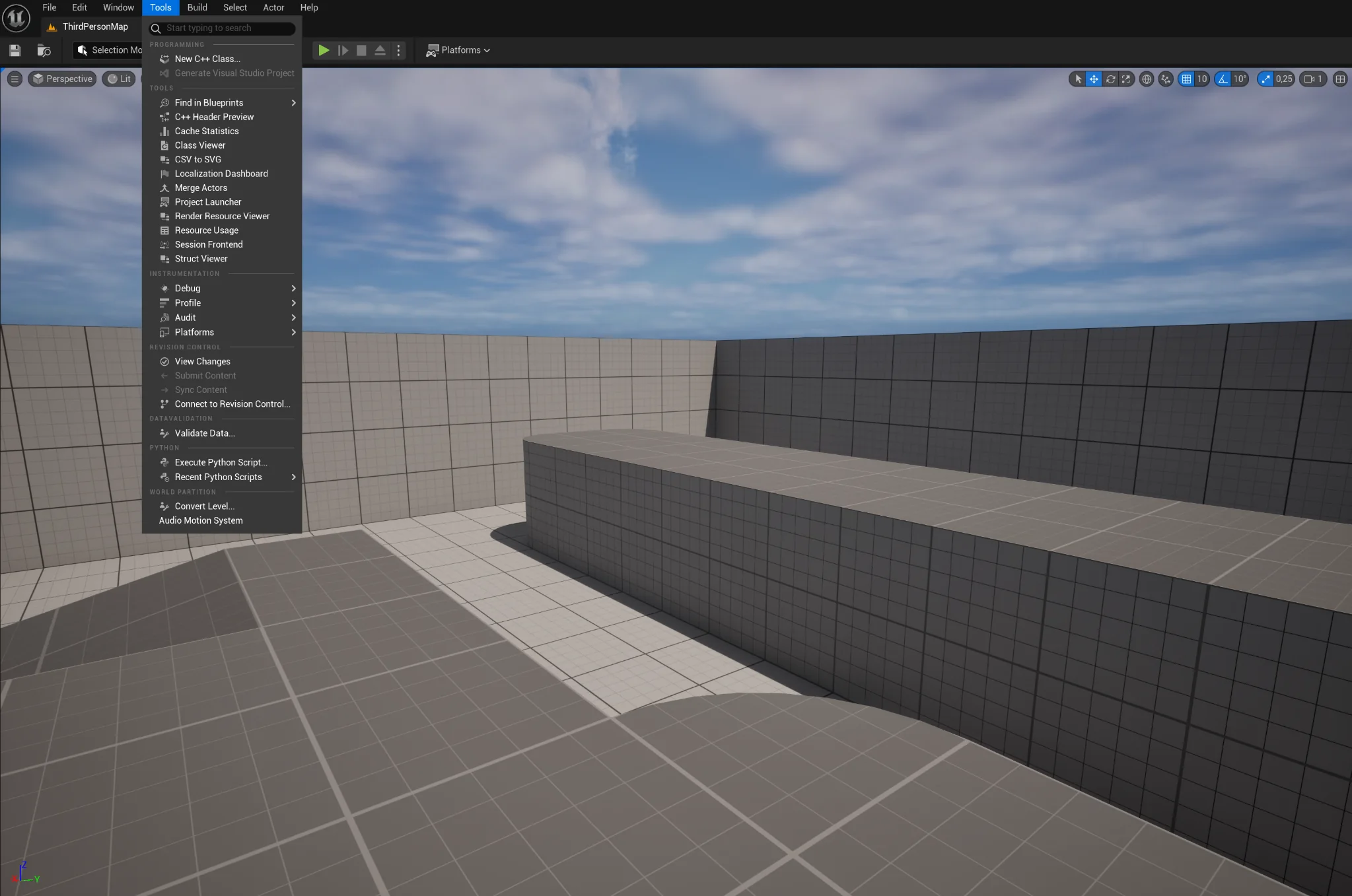
Editor entryTools → Audio Motion System
Runtime accessBlueprint + C++
Modules2 Runtime + 1 Editor
Current publisher validationWin64
Third-party runtime librariesNone in plugin Build.cs
Online service requiredNo
Built-in dataVocabulary / view data under Content/AMSData
Generated output root/Game/AudioMotion by default
Engine versions: Code Plugin files are distributed per Unreal Engine version. Use the package that matches the engine version of the project.
Localization: Documentation prose is available in 10 languages. Public C++ identifiers, Blueprint node names, asset names, and Unreal Editor control labels remain in English where matching the plugin UI is important.
GUIDE / 01

Installation

Get into the tool cleanly.

FAB / END USER

Install the engine package

  1. 01Add AMS to your Fab Library.
  2. 02In Epic Games Launcher, install the matching AMS package to the target Unreal Engine version.
  3. 03Open the project and enable Pautinka - Audio Motion System if prompted.
  4. 04Restart the Editor if plugin activation requires it.
  5. 05Open Tools → Audio Motion System.
SOURCE / DEVELOPMENT

Project plugin workflow

  1. 01Use the source package built for the exact Unreal Engine version.
  2. 02Place AudioMotionSystem under [Project]/Plugins/.
  3. 03Compile the project using the toolchain supported by that engine version.
  4. 04Do not copy Intermediate or Saved folders between machines.
Tools menu — Audio Motion System entry
Editor entry point.
GUIDE / 02

Quick Start

First successful preview.

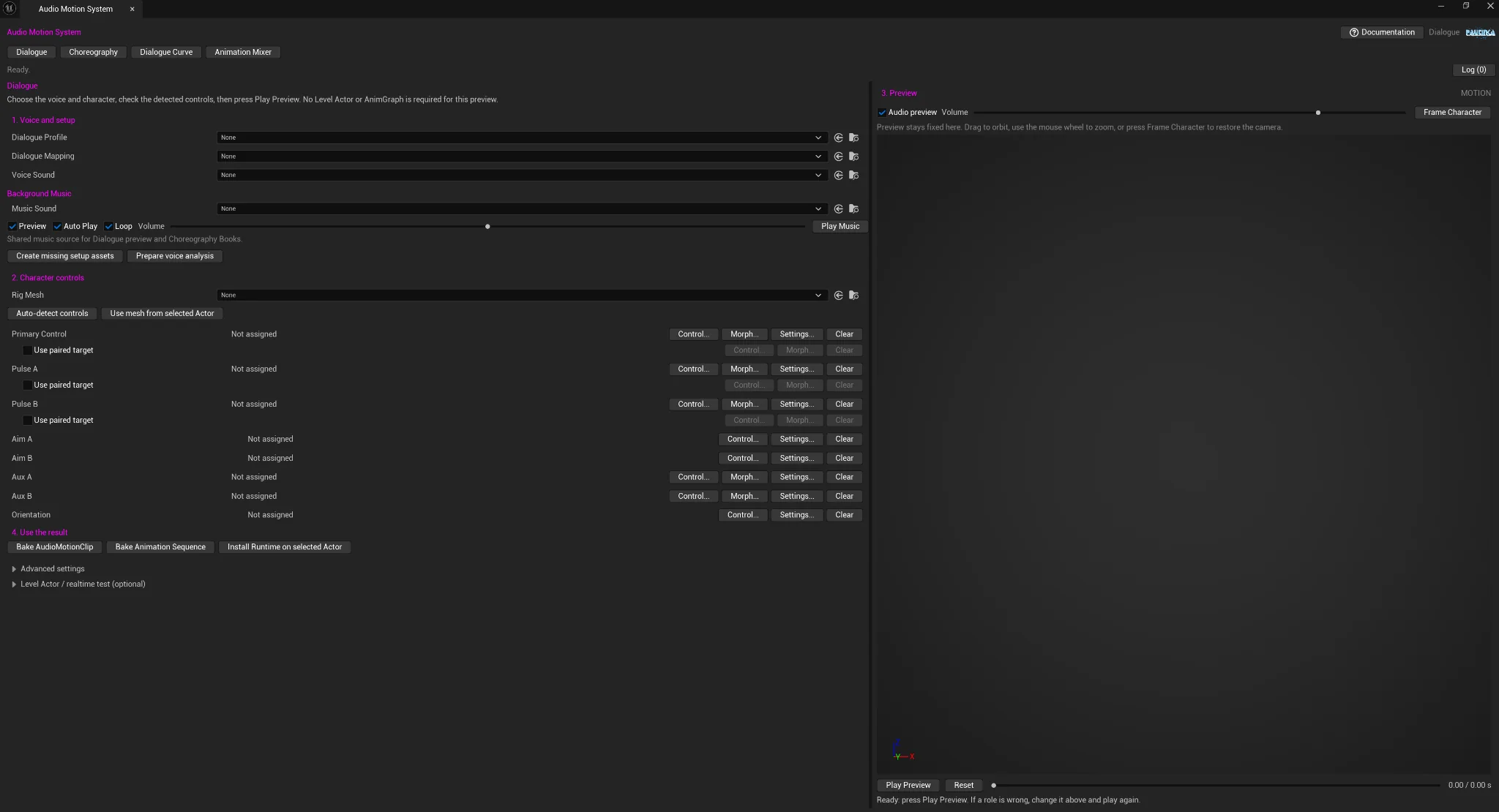
  1. 01Open Dialogue and choose a Dialogue Profile and Dialogue Mapping.
  2. 02Select the Voice Sound and prepare its analysis.
  3. 03Select the target Rig Mesh, run automatic control detection, and review the assignments.
  4. 04Press Play Preview and verify the result before baking or installing runtime setup.
  5. 05For runtime Blueprint use, start with Connect Audio Motion or a baked Audio Motion Clip.
FASTEST RUNTIME PATHConnect Audio MotionVoice Sound + Profile + Binding Profile
BAKED RUNTIME PATHConnect Audio Motion ClipReusable precomputed Dialogue data
WORKSPACE / 01

Voice-driven control

Dialogue Workspace.

Setup

  1. 01Choose or create the Dialogue Profile and Binding Profile.
  2. 02Choose Voice Sound; Background Music is optional.
  3. 03Prepare voice analysis.
  4. 04Choose Rig Mesh and run automatic control detection.
  5. 05Review assignments and preview.

Outputs

  • AudioMotionClip — reusable baked Dialogue frame data.
  • Animation Sequence — baked result for the selected Rig.
  • Runtime component setup — install on the selected Actor.
  • Background Music — synchronized independent music playback path.
Dialogue workspace overview
Dialogue setup and Preview workflow.
WORKSPACE / 02

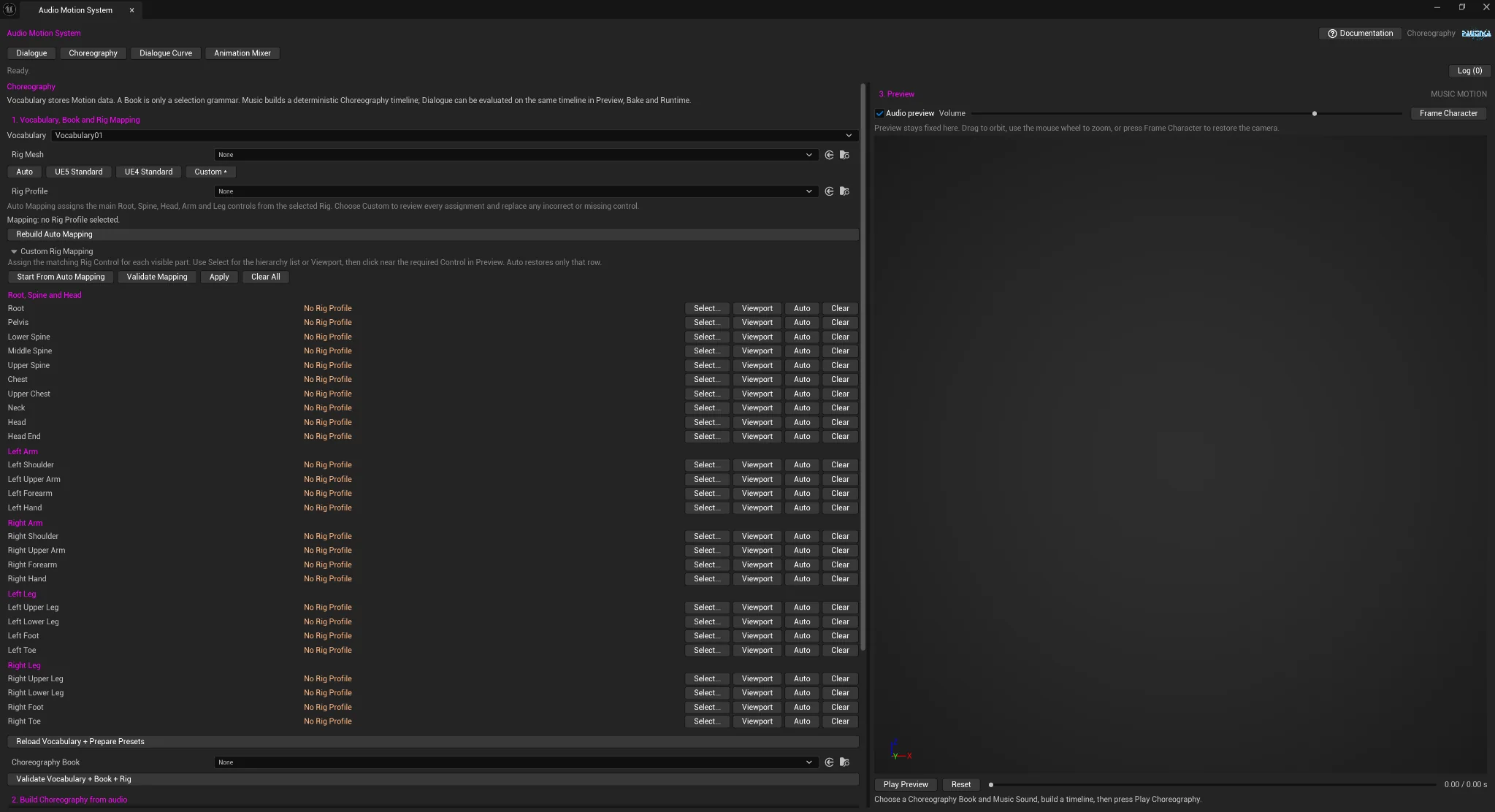
Music-driven Motion

Choreography Workspace.

Deterministic timeline

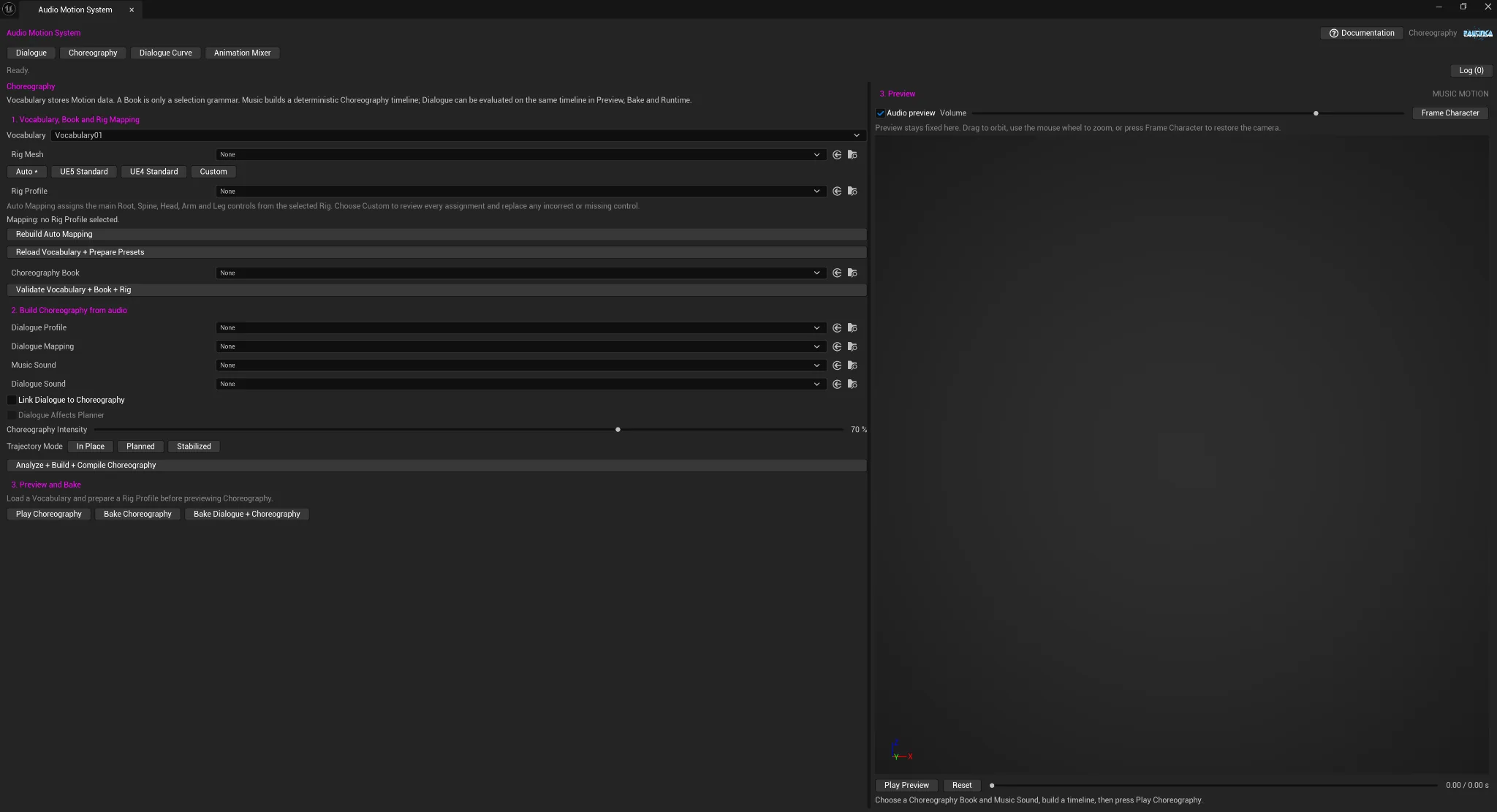
  1. 01Choose Vocabulary, target Rig Mesh, and Rig Profile.
  2. 02Choose Mapping mode and Choreography Book.
  3. 03Select Music Sound and optional Dialogue assets.
  4. 04Set Intensity and Trajectory Mode.
  5. 05Run Analyze + Build + Compile Choreography.
IN PLACE

Suppresses global travel.

Use for stationary playback.
PLANNED

Uses the planned trajectory.

Use when the sequence should travel.
STABILIZED

Uses the stabilized global trajectory path.

Use when planned travel needs stabilization.
Choreography workspace overview
Choreography planning and compiled track workflow.
Custom Rig Mapping
Automatic mapping is a starting point; custom mapping is the correction path.
WORKSPACE / 03

Scalar output

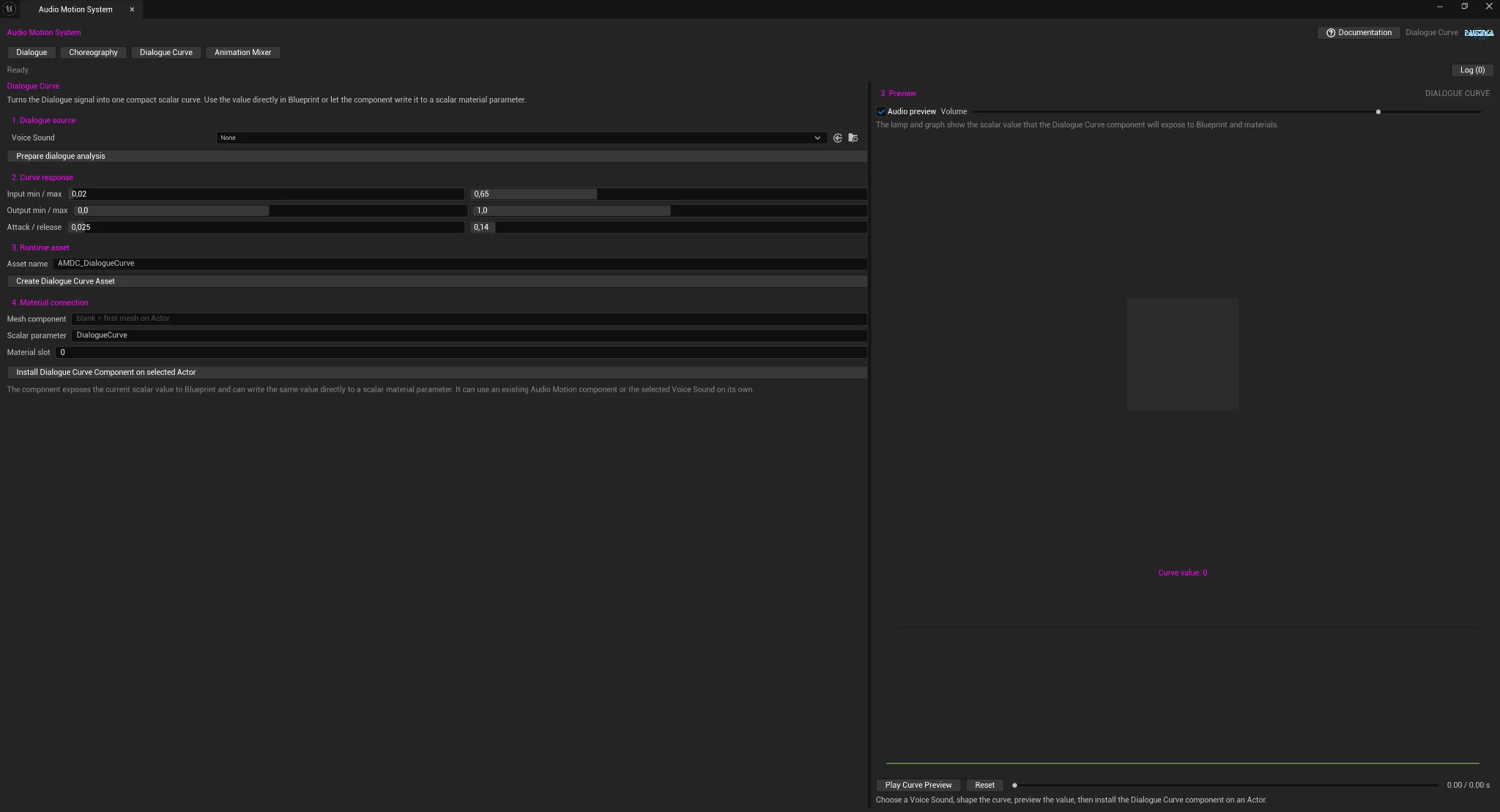
Dialogue Curve Workspace.

Portable runtime asset

Create an Audio Motion Dialogue Curve asset when you need one baked scalar value for Blueprint or a material parameter.

Input Min / MaxOutput Min / MaxAttackReleaseLoopMaterial Target

Runtime evaluation reads the baked curve. It does not need to repeat editor analysis.

Runtime connection

Connect Dialogue Curve Asset creates or reuses an Audio Motion Dialogue Curve component on the target Actor and starts it with the asset settings.

The current scalar is available through Get Dialogue Curve Value. If material output is enabled, the same value is written to the selected scalar parameter.

Dialogue Curve workspace
Dialogue Curve authoring and material connection.
WORKSPACE / 04

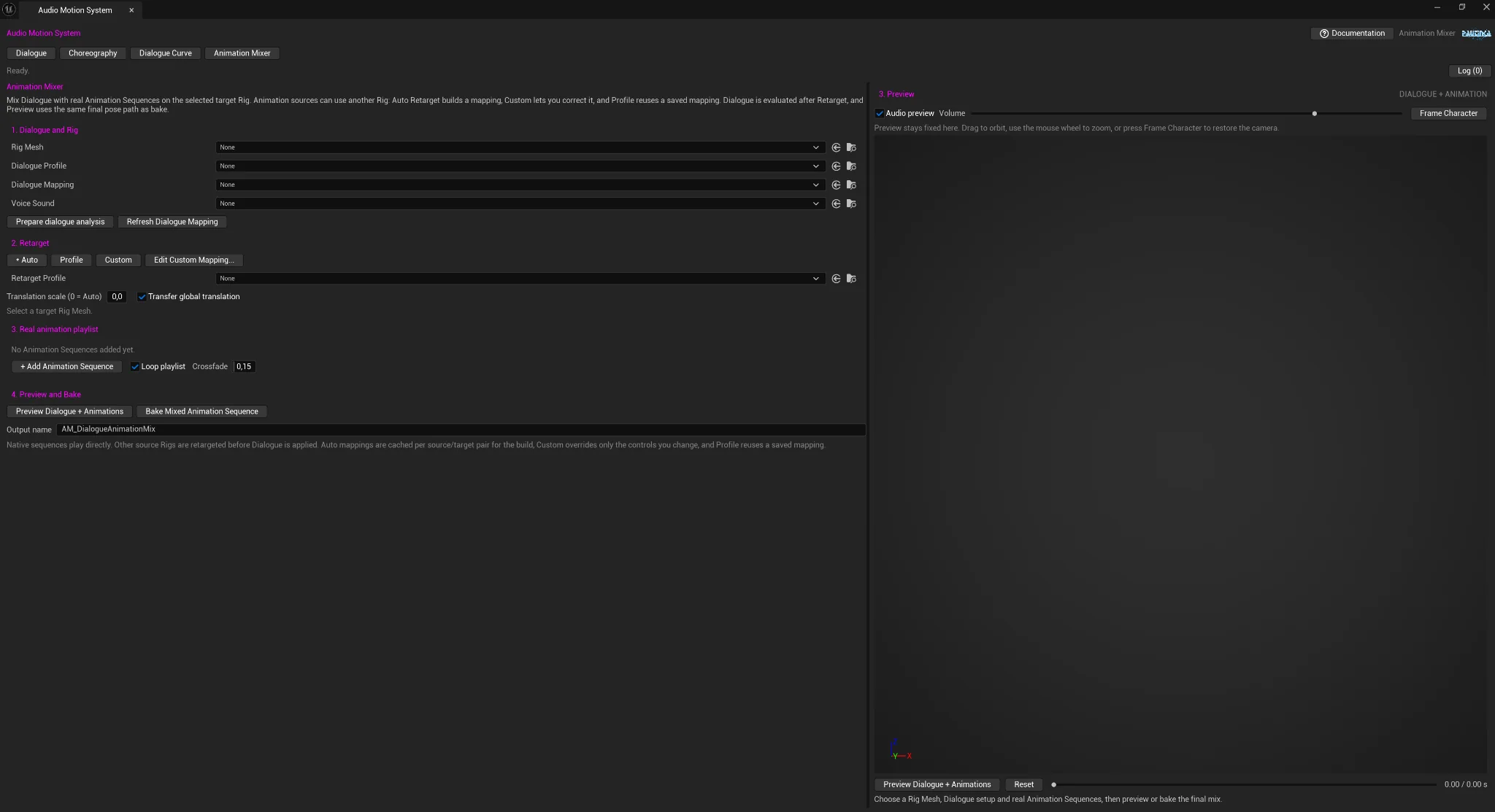
Animation Sequence + Dialogue

Animation Mixer Workspace.

  1. 01Select the target Rig Mesh, Dialogue setup, and Voice Sound.
  2. 02Add one or more Animation Sequences to the playlist.
  3. 03Choose Auto, Custom, or Profile retarget mode per source pair.
  4. 04Set playlist order, loop, crossfade, translation scale, and global translation transfer.
  5. 05Preview, then use Bake Mixed Animation Sequence.
AUTO

Builds a Source-to-Target mapping from reference hierarchy and geometry.

Native target-Rig animations bypass retargeting.
CUSTOM

Starts from Auto and lets you replace or clear the mappings that need correction.

Use for unusual or low-confidence cases.
PROFILE

Reuses a saved Retarget Profile for a known Source / Target pair.

Best for repeated production work.
Animation Mixer workspace
Animation Mixer playlist and retarget controls.
RUNTIME / 01

Architecture

Modules & data flow.

ModuleTypePurposeUse from
AudioMotionRuntimeRuntimeAudio evaluation, components, Blueprint helpers, assets, mapping, Choreography data.Game + Editor
AudioMotionAnimationRuntimeRuntime AnimGraph control node.Animation systems
AudioMotionEditorEditorTools window, asset factories, preview, authoring, bake, Animation Mixer.Editor only
Runtime dependency rule: Gameplay/runtime modules should depend on AudioMotionRuntime and, when needed, AudioMotionAnimation. Do not add an AudioMotionEditor dependency to shipping runtime code.

Dialogue runtime path

SoundWave / AudioComponent / Clip / Manual Envelope UAudioMotionComponent FAudioMotionFrame Binding Profile / Motion Sequence Target Actor / AnimGraph / Material

Built-in runtime data

The runtime module stages compact AMS Vocabulary and view files from Content/AMSData as NonUFS runtime dependencies.

*.amsvocab.json
*.amsvocabz
*.amsview.json

Project-side Vocabulary folders supported by the runtime build rules can also be staged when present.

API / BLUEPRINT

Primary integration nodes

Blueprint API.

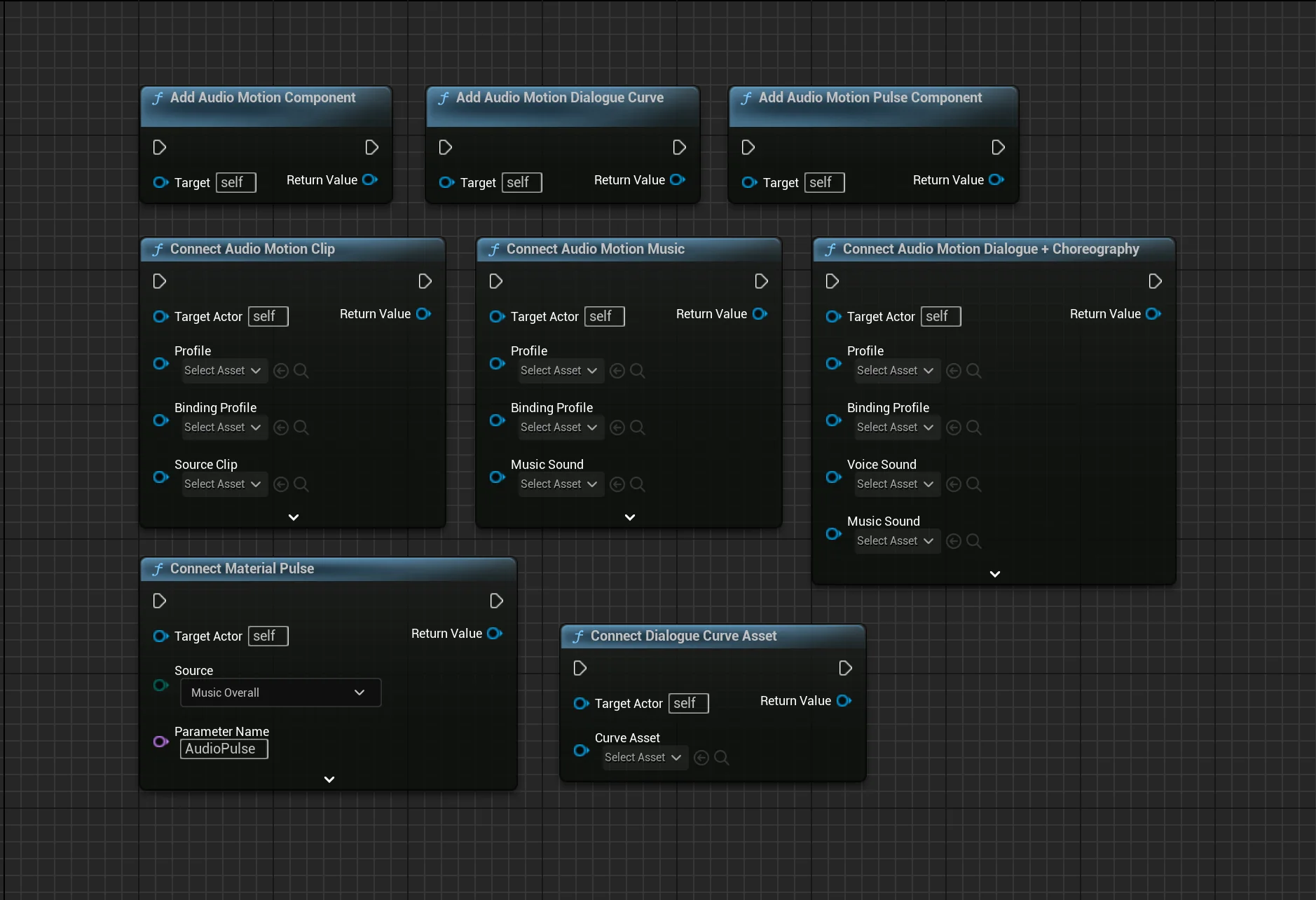
Blueprint helpers create or reuse AMS components on the target Actor. Required inputs are validated; a failed setup returns None / nullptr.

BlueprintCallable · Audio Motion

Connect Audio Motion

UAudioMotionComponent*

Creates or reuses the main Audio Motion Component, prepares the Voice Sound path, rebuilds Dialogue bindings, connects the target Rig component, and starts processing.

Required
Target Actor, Profile, Binding Profile, Source Sound
Advanced
Target Rig Component, Play Audio = true, Loop = false
Returns
The connected Audio Motion Component, or None if required inputs are missing.
BlueprintCallable · Audio Motion

Connect Audio Motion Clip

UAudioMotionComponent*

Connects a baked Audio Motion Clip to the target Actor. No source audio playback is required by this path.

Required
Target Actor, Profile, Binding Profile, Source Clip
Advanced
Target Rig Component, Loop = false
Input mode
Audio Motion Clip
BlueprintCallable · Audio Motion | Music

Connect Audio Motion Music

UAudioMotionComponent*

Configures the main component for music-driven processing with the selected SoundWave as Background Music. Processing can continue independently of a Voice source.

Required
Target Actor, Profile, Binding Profile, Music Sound
Advanced
Target Rig Component, Loop = true
Background Music
Starts when processing starts.
BlueprintCallable · Audio Motion | Music

Connect Audio Motion Dialogue + Choreography

UAudioMotionComponent*

Connects a Voice Sound and independent Background Music to the same Audio Motion Component. The component is configured to keep processing when the Voice playback stops so the music path can continue.

Required
Target Actor, Profile, Binding Profile, Voice Sound, Music Sound
Advanced
Target Rig Component, Loop Music = true
BlueprintPure · Audio Motion

Get Audio Motion Component

UAudioMotionComponent*

Finds the first Audio Motion Component attached to the target Actor. Returns None when the Actor has no such component.

BlueprintCallable · Dialogue Curve

Connect Dialogue Curve

UAudioMotionDialogueCurveComponent*

Creates or reuses a Dialogue Curve component and connects its scalar output to Blueprint and, by default, a scalar material parameter.

Defaults
Parameter Name = DialogueCurve, Material Slot = 0
Optional
Standalone Sound, Target Component Name
Source
Uses an existing Audio Motion Component when available, or the optional standalone sound.
BlueprintCallable · Dialogue Curve

Connect Dialogue Curve Asset

UAudioMotionDialogueCurveComponent*

Creates or reuses a Dialogue Curve component and applies the complete generated Dialogue Curve asset: source sound, baked curve, response settings, loop state, material target, material slot, and parameter name.

BlueprintCallable · Material Pulse

Connect Material Pulse

UAudioMotionPulseComponent*

Creates or reuses a compact scalar Audio Pulse component. The source can be Voice, overall music energy, frequency bands, onset, beat, or a custom Audio Motion channel.

Defaults
Source = Music Overall, Parameter Name = AudioPulse, Material Slot = 0
Optional
Standalone Sound, Target Component Name
Blueprint helper nodes
Recommended Blueprint API overview image.
API / COMPONENTS

Runtime control

Component API.

UAudioMotionComponentMain runtime evaluator

Header: AudioMotionComponent.h · Module: AudioMotionRuntime

SetAudioSource(UAudioComponent*)Sets the Audio Component input and updates source state.
SetSourceSound(USoundWave*)Sets the SoundWave source path.
SetSourceClip(UAudioMotionClip*)Sets the baked Audio Motion Clip source.
StartProcessing(bool)Starts evaluation; optionally resets playback time.
StopProcessing(bool)Stops evaluation; optionally stops the source audio.
ResetProcessing(float)Resets processor state to a requested time.
PushEnvelopeValue(float)Supplies a manual envelope value for Manual Envelope input mode.
EvaluateAtTime(float,float)Evaluates an explicit time and envelope value.
EvaluateSourceAtTime(float)Evaluates the currently configured source at a requested time.
ApplyExternalFrame(FAudioMotionFrame,bool)Applies a prebuilt frame and optionally applies automatic bindings.
RefreshAutomaticConnection()Resolves automatic runtime target connection again.
ResetAutomaticBindings()Clears cached automatic binding state.
SetTargetSkeletalMesh(...)Sets an explicit target Rig component for runtime application.
GetChannelValue(EAudioMotionChannel)Reads one value from the current frame.
GetPlaybackTimeSeconds()Returns the current main playback clock.
GetSourceDurationSeconds()Returns the configured source duration when available.
IsProcessing()Returns the processing state.
SetBackgroundMusic(...)Sets the independent Background Music SoundWave.
PlayBackgroundMusic(float)Starts Background Music at the requested local time.
StopBackgroundMusic()Stops Background Music playback.
SetBackgroundMusicVolume(float)Updates Background Music volume.
IsBackgroundMusicPlaying()Returns Background Music playback state.

Blueprint events

On Frame UpdatedOn Speech Value UpdatedOn Speech StartedOn Speech Stopped
UAudioMotionPulseComponentCompact scalar audio output

Header: AudioMotionPulseComponent.h · Module: AudioMotionRuntime

Reads a selected AMS channel or standalone sound, maps it through Input/Output ranges with attack/release smoothing, optionally writes the value to a dynamic material scalar, and exposes a threshold event.

StartPulse()Starts ticking and source evaluation.
StopPulse(bool)Stops evaluation; optionally stops standalone audio.
SetStandaloneSound(USoundWave*,bool)Changes the standalone source and optionally plays immediately.
GetPulseValue()Returns the current scalar output.

Blueprint events

On Pulse Value UpdatedOn Pulse
UAudioMotionDialogueCurveComponentBaked Dialogue Curve playback

Header: AudioMotionDialogueCurveComponent.h · Module: AudioMotionRuntime

Derived from Audio Motion Pulse Component. When a Curve Asset is assigned, its baked curve becomes the scalar source and its playback/material settings are copied into the component.

SetCurveAsset(UAudioMotionDialogueCurveAsset*,bool)Assigns the asset and optionally starts its source sound.
GetDialogueCurveValue()Returns the current baked-curve scalar.
API / C++

Public headers

C++ API.

Module dependencies

Add only the module that your own code actually uses.

PublicDependencyModuleNames.AddRange(new[]
{
    "AudioMotionRuntime",
    "AudioMotionAnimation" // only when your runtime animation module needs FAnimNode_AudioMotion
});
Editor-only: Add AudioMotionEditor only from an Editor module. Never make a shipping runtime module depend on the AMS Editor module.
Public typeHeaderPurpose / key public API
UAudioMotionComponentAudioMotionComponent.hMain runtime evaluator. Source selection, processing clock, frame evaluation, automatic connection, Background Music, channel reads.
UAudioMotionBlueprintLibraryAudioMotionBlueprintLibrary.hStatic convenience layer used by the Blueprint Connect nodes. Also callable directly from C++.
UAudioMotionProfileAudioMotionProfile.hPrimary Data Asset containing envelope, Dialogue, music, and evaluation settings.
UAudioMotionBindingProfileAudioMotionBindingProfile.hPrimary Data Asset for target mapping. Public helpers: FindDialogueRole, EnsureDialogueRoles, RebuildDialogueBindings.
UAudioMotionClipAudioMotionClip.hBaked Dialogue curves. EvaluateChannel, EvaluateFrame, BuildFromFrames, ClearClip, IsEmpty.
UAudioMotionDialogueCurveAssetAudioMotionDialogueCurveAsset.hPortable scalar curve asset. EvaluateCurve and GetSourceSound.
UAudioMotionPulseComponentAudioMotionPulseComponent.hScalar audio reaction component with material output and trigger events.
UAudioMotionDialogueCurveComponentAudioMotionDialogueCurveComponent.hPulse-derived component that evaluates a baked Dialogue Curve asset.
FAudioMotionDialogueProcessorAudioMotionDialogueProcessor.hDeterministic Dialogue processor. Reset(seed), Evaluate(...).
FAudioMotionMusicAnalyzerAudioMotionMusicAnalyzer.hMusic analysis helper for SoundWave or Audio Component evaluation.
FAudioMotionFrameAudioMotionTypes.hShared frame container. GetChannel / SetChannel plus Dialogue and music channel values.
UAMSMotionDataSubsystemAMSMotionDataSubsystem.hEngine subsystem that loads compact Vocabulary data. ReloadData, GetVocabulary, GetDefaultVocabulary, GetVocabularyIds.
UAMSMotionVocabularyAMSMotionVocabulary.hVocabulary metadata and Motion references. FindMotion, GetMotionCount, ValidateVocabulary.
UAMSMotionClipAMSMotionClip.hMeasured Motion Unit data. Track evaluation, pose application, authoring validation, transition metadata.
UAMSMotionLibraryAMSMotionLibrary.hPlanner-facing candidate library built from Vocabulary and Book data.
UAMSPerformanceBookAMSPerformanceBook.hChoreography policy / grammar Data Asset. Built-in book helpers, validation, family rules.
FAMSPerformancePlannerAMSPerformancePlanner.hDeterministic static BuildPlan interface from Book/Library + Analysis + Planner Settings into a Motion Sequence.
UAMSMotionSequenceAMSMotionSequence.hScheduled Choreography sequence. Duration/time normalization, pose evaluation, compiled-track build and validation.
UAMSRigProfileAMSRigProfile.hRig Mapping profile. Resolve mapping, build from reference hierarchy, manual overrides, validation, reference scale.
FAnimNode_AudioMotionAnimNode_AudioMotion.hRuntime AnimGraph control node. Reads the frame from the owning Audio Motion Component by default.

C++ example: connect runtime Voice processingAudioMotionRuntime
#include "AudioMotionBlueprintLibrary.h"
#include "AudioMotionComponent.h"

UAudioMotionComponent* ConnectAMS(
    AActor* TargetActor,
    UAudioMotionProfile* Profile,
    UAudioMotionBindingProfile* BindingProfile,
    USoundWave* VoiceSound)
{
    return UAudioMotionBlueprintLibrary::ConnectAudioMotion(
        TargetActor,
        Profile,
        BindingProfile,
        VoiceSound,
        nullptr,
        true,
        false);
}
C++ example: evaluate a baked Dialogue Curve assetAudioMotionRuntime
#include "AudioMotionDialogueCurveAsset.h"

float ReadDialogueCurve(
    const UAudioMotionDialogueCurveAsset* CurveAsset,
    float TimeSeconds)
{
    return CurveAsset
        ? CurveAsset->EvaluateCurve(TimeSeconds, false)
        : 0.0f;
}
REFERENCE / 01

Assets & data types

What gets stored.

Audio Motion Profile

Envelope, Dialogue, music analysis, and evaluation-rate settings.

Audio Motion Binding Profile

Target mappings and generated Dialogue bindings.

Audio Motion Clip

Baked reusable frame-channel curves.

Audio Motion Dialogue Curve

Source SoundWave plus one baked scalar curve and material settings.

AMS Rig Profile

Rig Mapping, manual overrides, topology data, reference scale.

AMS Motion Vocabulary

Vocabulary metadata and references to Motion Units.

AMS Motion Library

Planner candidate library built from Vocabulary and Book data.

AMS Choreography Book

Selection policy / grammar used by the Planner.

AMS Motion Sequence

Scheduled Choreography entries and optional compiled track.

Animation Mixer Retarget Profile

Editor asset storing a reusable Source/Target Mapping and translation settings.

Blueprint-visible enumsAudioMotionTypes.h + AMS data headers
EAudioMotionModeEAudioMotionInputModeEAudioMotionChannelEAudioMotionPulseSourceEAudioMotionTransformChannelEAudioMotionTargetTypeEAudioMotionDialogueRoleEAudioMotionDialogueTargetTypeEAMSRigProfileKindEAMSMotionSequenceModeEAMSTrajectoryModeEAMSMotionCurveModeEAMSMotionActionKindEAMSMotionPathKindEAMSMotionDirectionEAMSMotionLevelEAMSMotionTimeQualityEAMSMotionForceQualityEAMSMotionFlowQualityEAMSSupportState

Exact C++ identifiers are listed for API accuracy. The editor presents neutral display labels for the main production-facing Dialogue roles.

Core Blueprint-visible structsData exchange / settings
FAudioMotionFrameFAudioMotionMusicSettingsFAudioMotionEnvelopeSettingsFAudioMotionDialogueSettingsFAudioMotionValueMappingFAudioMotionDialogueTargetConfigFAudioMotionDialogueRoleTargetFAudioMotionMorphBindingFAudioMotionMaterialScalarBindingFAudioMotionSceneBindingFAMSPerformanceAnalysisFAMSPerformancePlannerSettingsFAMSRigSlotMappingFAMSRigManualOverrideFAMSMotionKeyFAMSMotionTrack
REFERENCE / 02

Asset safety

Generated files stay organized.

Mesh-based folders

AMS uses the configured Output Folder as a root. Mesh-dependent assets are stored under a folder named after the selected Rig Mesh.

/Game/AudioMotion/
  SK_MyRig/
    Profiles/
    Clips/
    Animations/
    Retarget/
    Choreography/
      RigProfiles/
      Generated/
  DialogueCurves/

Unique final names

Generated final assets use Unreal unique naming instead of silently replacing an existing asset.

AM_DialogueAM_Dialogue_1AM_Dialogue_2AM_Dialogue_3

Dialogue Curve assets are shared and are not tied to a Rig Mesh.

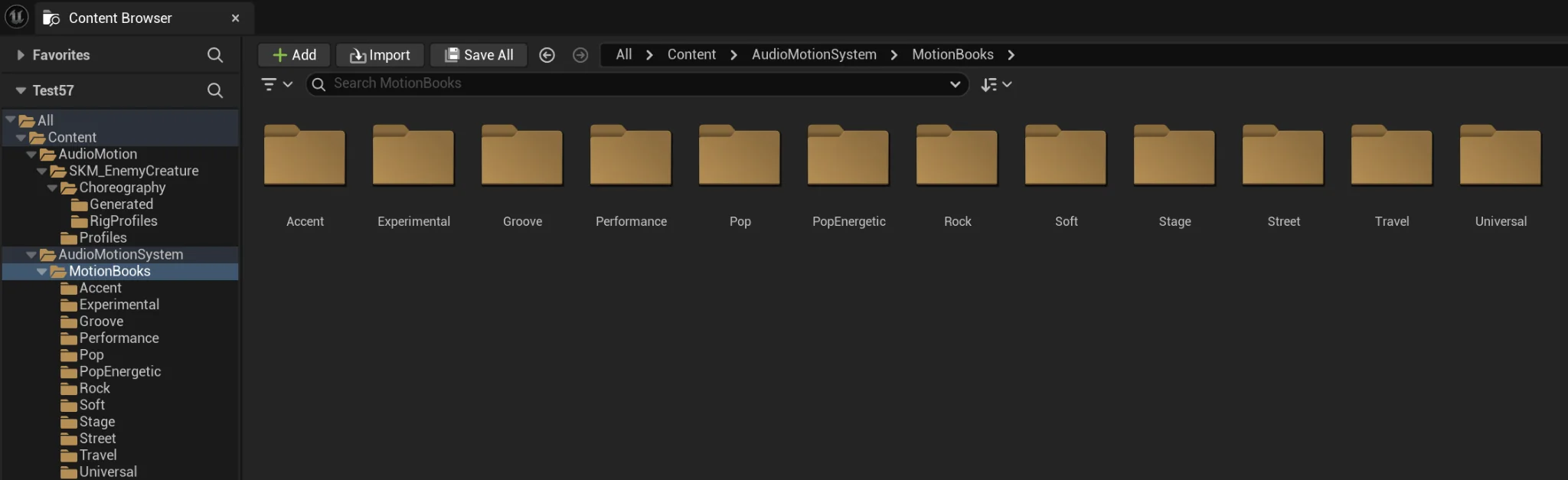
Content Browser generated folders
Recommended generated-asset organization screenshot.
SYSTEM / 01

Compatibility

Supported workflow boundaries.

  • Use the AMS package built for the exact Unreal Engine version of the project.
  • Auto Mapping and Auto Retarget are helpers; unusual custom Rigs must be reviewed.
  • Retargeting requires enough compatible Source and Target structure to represent the requested motion.
  • Preview and Bake are designed to share the production evaluation path, but final packaged-project testing is still required.
  • Source authoring files are not required by the distributed runtime plugin.
  • Built-in shared Motion data is common and is not duplicated into every Mesh output folder.
  • Runtime components do not declare project-specific network replication policy; multiplayer projects should replicate the inputs or results required by their own design.
SYSTEM / 02

Troubleshooting

When something doesn't move.

Audio Motion System is not visible under Tools.

Confirm that the plugin is enabled for the project and that the Editor was restarted after activation. Also confirm that the package matches the project's Unreal Engine version.

Dialogue preview has no useful response.

Verify the Voice Sound analysis data, Profile/Binding Profile selection, target Rig Mesh, and automatic assignments. Review any missing or suspicious mappings before rebuilding or baking.

Choreography plays but the target Rig result is incorrect.

Validate the Rig Profile. Switch to Custom Mapping, start from the automatic base, correct only the incorrect rows, Validate, Apply, then rebuild the compiled Choreography track.

Music analysis is unavailable after choosing a SoundWave.

Follow the editor status message. When AMS enables the required analysis settings, save the SoundWave and let Unreal rebuild its audio analysis data before running Analyze + Build + Compile again.

Dialogue Curve does not update a material.

Confirm that material output is enabled, the scalar parameter exists, the Material Slot is correct, and the Target Component Name either matches the desired mesh component or is left blank so AMS can use the first suitable mesh component.

Animation Mixer retarget result needs correction.

Use Custom mode, begin from Auto Mapping, replace or clear only the incorrect rows, and save a reusable Retarget Profile when the Source/Target pair will be used again.

A C++ project fails to compile after changing engine versions.

Install/use the AMS source package for that exact engine version and rebuild against that engine's supported compiler/toolchain. Do not reuse Binaries or Intermediate output from another engine version.

SUPPORT

Pautinka

Support & reporting.

Before sending a report

Include the Unreal Engine version, AMS version, whether the problem appears in Editor Preview / Runtime / Bake, the exact reproduction steps, and the relevant Unreal log excerpt.

For Mapping or Animation Mixer issues, also include the Source/Target Rig type and whether Auto, Custom, or Profile mode was used.

PAUTINKA — AUDIO MOTION SYSTEM 1.0

Audio in. Motion out.

Editor authoring, reusable assets, Blueprint integration, and public C++ runtime APIs in one production workflow.

Pautinka Digital Develop Studio