
Limited-Time Free Until July 28 2026
Fab has launched another rotation of its Limited-Time Free program, giving developers and digital artists an opportunity to add three commercial products to their libraries at no cost. The current selection is available until July 28, 2026, at 9:59 AM ET. Fab refreshes this sponsored content every two weeks, so the claim window is deliberately short.
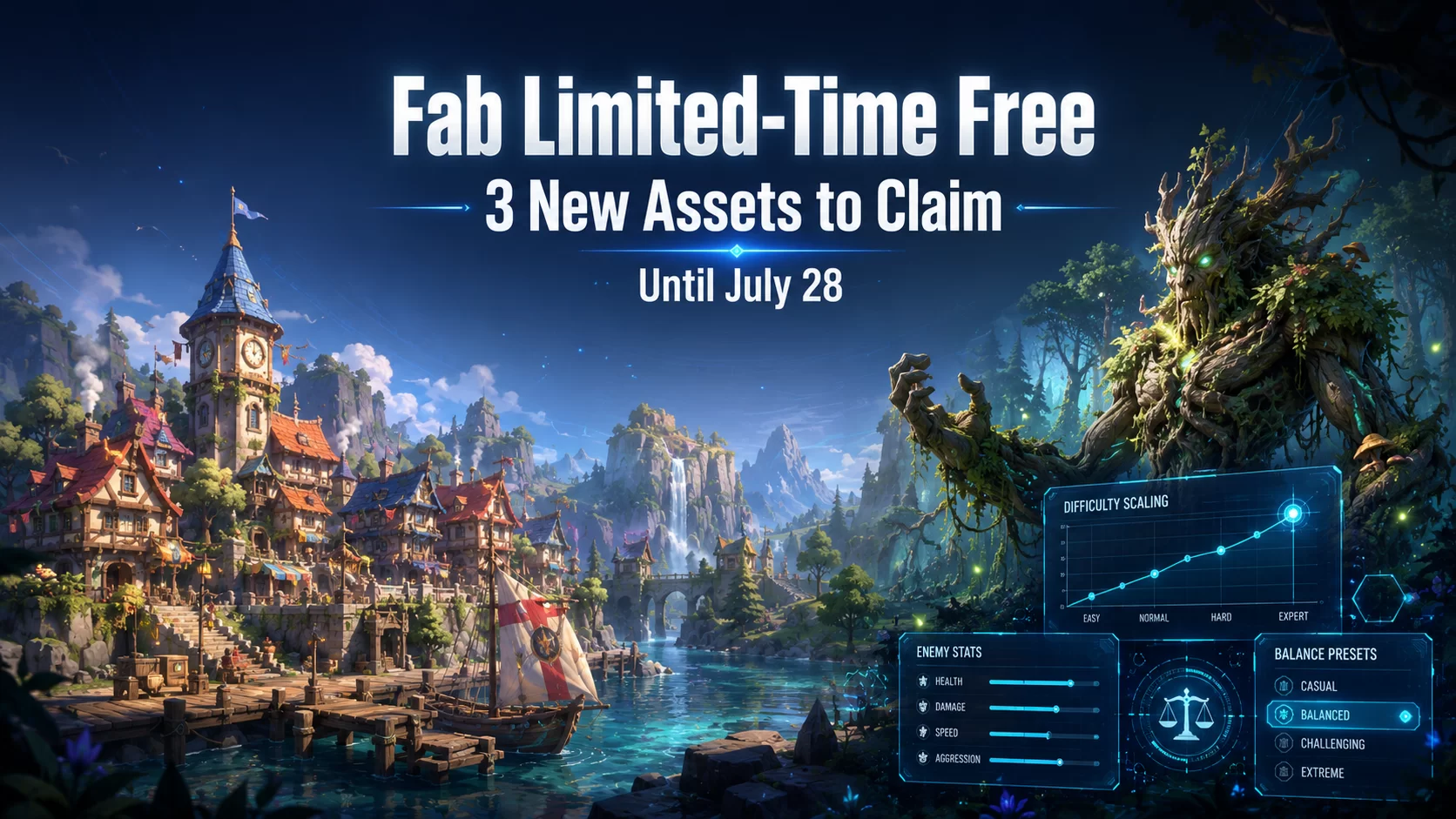
This time, the collection covers three very different areas of game production: environment building, gameplay balancing, and fantasy character design. The lineup includes Stylized Village by Hivemind, Ultimate Difficulty Scaling by BlueprintsLab, and Pack of Tree Ents by SAN 3D Art. Together, they provide a useful mix of visual content and development tools rather than focusing on a single production discipline.
Stylized Village by Hivemind
The largest environment pack in the current giveaway is Stylized Village, a complete medieval-fantasy island created specifically for Unreal Engine 5.
Instead of offering only a small collection of disconnected buildings and props, the product includes a finished one-square-kilometre island environment that can be explored, modified, or used as the foundation for a new game level. Its existing layout combines several distinct locations, including forests, a central village, seaside docks, and a magical mushroom woodland.
The pack contains 248 meshes, giving level designers enough material to expand the included map or construct completely new locations in the same visual style. The asset library covers architecture, vegetation, environmental props, trees, mushrooms, harbour elements, and additional decorative objects.
Hivemind has also included stylized visual effects. Fireplaces, butterflies, and magical woodland details help the environment feel more like a functioning fantasy world rather than an empty architectural demonstration. The product supports both Lumen and Nanite in Unreal Engine 5.0 and later.
This makes Stylized Village particularly useful for:
- fantasy RPGs and action-adventure games;
- exploration and quest prototypes;
- stylized cinematics and animated shorts;
- medieval town scenes;
- game jams that need a substantial environment quickly;
- developers studying environment composition, foliage placement, and biome transitions.
The finished island can significantly reduce the amount of time required to reach a playable prototype. A developer could use it immediately as a testing ground for character movement, combat, AI navigation, dialogue systems, quests, lighting, or cinematic cameras.
At the same time, the product should not be treated as a universally suitable drop-in world. Its strong stylized direction will influence the appearance of every character, effect, and interface placed inside it. Projects aiming for realism will need substantial reworking, while stylized fantasy games may be able to integrate it much more naturally.
For environment artists, the real value is not limited to the finished demonstration map. The modular meshes, biome construction, foliage arrangement, and visual hierarchy can all serve as practical references for building readable large-scale environments.
Ultimate Difficulty Scaling by BlueprintsLab
The second product approaches game development from an entirely different direction. Ultimate Difficulty Scaling, or UDS, is an Unreal Engine plugin designed to centralize the management of difficulty-related variables.
Difficulty settings are often implemented directly inside individual Blueprints. Player health may be adjusted in one Blueprint, enemy damage in another, ammunition values somewhere else, and AI behaviour in several additional systems. As a project grows, these scattered values become increasingly difficult to locate, compare, and maintain.
UDS replaces that fragmented workflow with a single dockable editor. Developers can add a Blueprint, select its variables, and assign different values for each difficulty level from one central interface. The plugin can access variables located directly in a Blueprint as well as values nested inside components and structures.
The interface is type-aware. Boolean variables receive checkboxes, enumerations use appropriate dropdown menus, and numerical values are entered through validated fields. Developers can create an unlimited number of custom difficulty levels rather than being restricted to the traditional Easy, Medium, and Hard presets.
Another useful feature is its non-destructive implementation. According to the product description, UDS adds a lightweight Actor Component without rewriting existing event graphs. It also provides a Blueprint API for changing difficulty during gameplay and includes persistence for saving the player’s selected setting between sessions.
Version 2.0 introduces optional AI-assisted tuning. Developers can describe a desired difficulty curve in natural language and receive suggested values. The plugin supports several external providers—including OpenAI, Anthropic, Gemini, DeepSeek, and OpenAI-compatible local models—with users supplying their own API key. Proposed changes are displayed for review before they are applied.
That functionality may help generate an initial balancing pass, but it should not replace proper playtesting. Difficulty is influenced by far more than numerical progression: level design, enemy behaviour, animation timing, player knowledge, input method, readability, and mechanical complexity all affect the final experience. AI-generated values are therefore best treated as suggestions rather than finished balance decisions.
UDS is likely to be most valuable for projects with many interconnected gameplay variables, including:
- action RPGs;
- survival games;
- shooters;
- roguelites;
- strategy games;
- games with New Game Plus modes;
- accessibility presets;
- projects that expect frequent balancing updates.
Even a relatively small game can benefit from a centralized configuration tool. It becomes much easier to test alternative balance profiles when developers do not have to search through dozens of Blueprints every time a value changes.
Pack of Tree Ents by SAN 3D Art
The third free product is Pack of Tree Ents, a fantasy creature collection containing four animated tree characters based on different species: oak, ash, birch, and spruce.
Each creature has its own silhouette, branch structure, foliage arrangement, and mesh complexity. All four models include 47 animations, giving the pack substantially more production value than a collection of static forest statues. The listed vertex counts range from approximately 24,000 for the lighter oak and birch models to more than 78,000 for the ash creature.
The characters are rigged for the Unreal Engine 5 Epic skeleton and are intended to support retargeting. Fab lists Unreal Engine, Unity, and FBX among the available formats, making this the most portable visual asset in the current rotation.
Tree creatures can fill several roles in a fantasy project. They could appear as hostile forest guardians, ancient NPCs, summoned companions, environmental bosses, neutral creatures, or living landmarks. Using all four variants together also makes it possible to build a small creature faction without repeating exactly the same model throughout a level.
The pack would work especially well in:
- fantasy RPGs and MMORPG prototypes;
- enchanted forest environments;
- tower defence games;
- strategy and tactical projects;
- creature showcases;
- cinematics involving nature-based magic;
- boss encounters and guardian characters.
The included animations make the models suitable for rapid gameplay tests. A designer can evaluate scale, collision, combat spacing, animation timing, and navigation before investing in a custom creature pipeline.
There are still technical considerations. The models have noticeably different vertex counts, and dense foliage can become expensive when many creatures are visible simultaneously. Developers targeting mobile hardware, virtual reality, or scenes containing large groups should inspect material complexity, skeletal cost, texture sizes, shadows, and level-of-detail behaviour before using the characters extensively.
Artistically, the tree ents may also require material adjustments to match another environment. Bark colour, leaf saturation, roughness, subsurface response, and lighting can make the difference between a creature that belongs in the scene and one that clearly originated from a separate asset pack.
A Well-Balanced Free Rotation
This Fab rotation is stronger than it may initially appear because the three products solve different production problems.
Stylized Village offers immediate visual scale and a ready-made location for gameplay or cinematic work. Ultimate Difficulty Scaling addresses a less visible but important problem in Blueprint organisation and game balancing. Pack of Tree Ents supplies animated characters that can populate a fantasy world or provide the basis for enemy and boss encounters.
There is also a natural combination between the two visual packs. The tree ents could be placed inside the forests and magical areas of Stylized Village, while UDS could control their health, damage, movement parameters, or encounter difficulty. That does not automatically create a finished game, of course, but it does create a useful foundation for an action-RPG prototype, technical demonstration, or game-jam project.
How to Claim the Assets
Fab allows signed-in users to add free products directly to My Library after accepting the applicable end-user licence agreement. Products acquired through Fab can then be accessed through the website, Fab integrations, or the Epic Games Launcher, depending on the formats provided by the publisher.
The Fab Standard License generally permits commercial and private use, modification, and incorporation of acquired assets into projects. It does not permit users to resell or redistribute the original assets as standalone products. Developers should still review the licence information shown on each listing before incorporating content into production.
The current Limited-Time Free selection is available only until July 28 at 9:59 AM ET. Even without an immediate project for all three products, adding them to the library now can provide useful options for future prototypes, environment studies, gameplay experiments, and fantasy productions.